3 Forces Converging to Shift the Marketplace Right Now
In last week’s issue of Anti-Generic (read it here if you missed it), I shared some things I never shared before, including how I stubbornly resisted adopting AI for two solid years and lost major momentum in my business, before going all in and embracing the opportunities that are present all around us, right at this moment.
So today, I’m going to share what I’m seeing right now in the marketplace, and three distinct colliding forces that are re-shaping the world:
Force #1: The Erosion of the Institution
We are living in an age where we no longer feel we can depend on our major institutions.
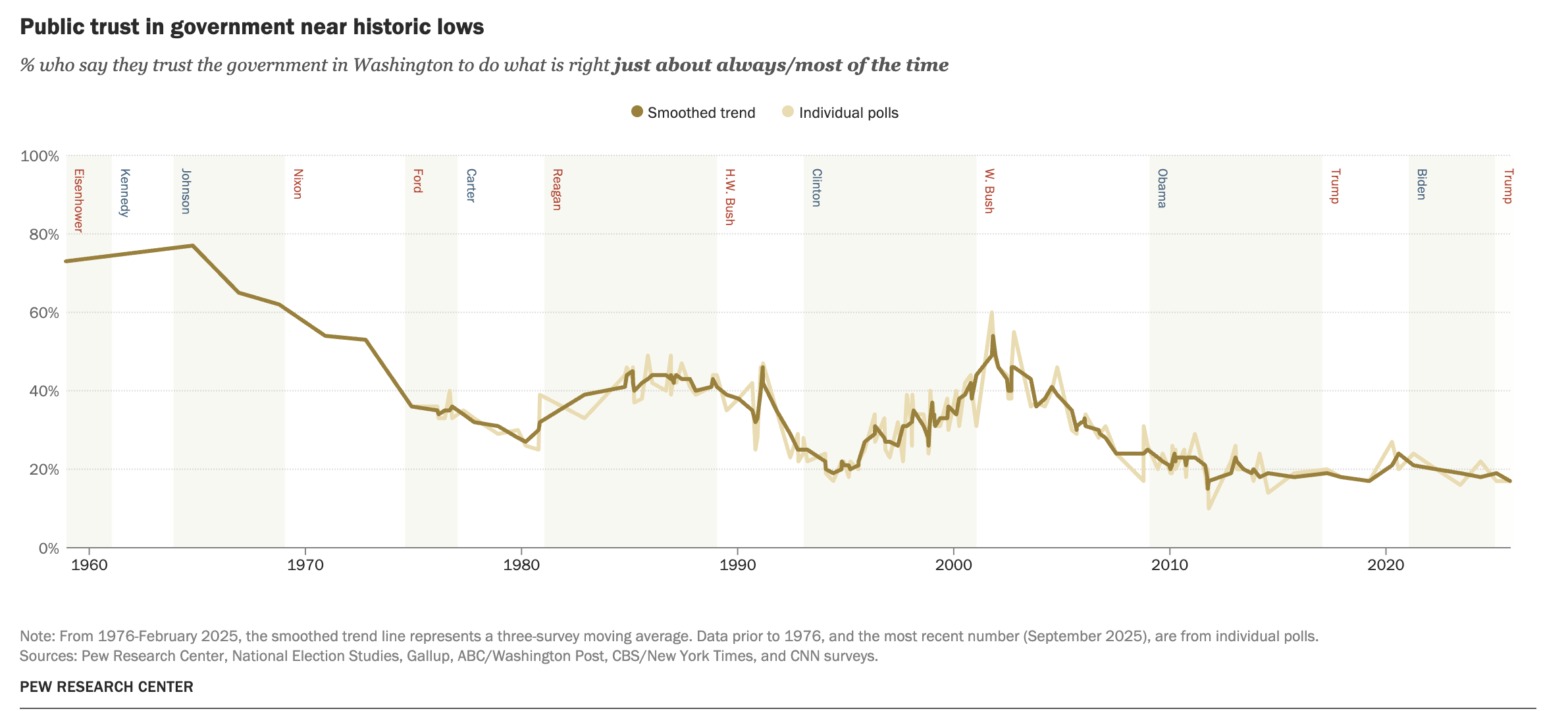
We used to have trust in our governments. We believed that leaders had our best interests at heart. But now, only 2% of Americans trust the government to do what’s right “just about always,” and only 15% believe the government will do what’s right “most of the time.” Source, Pew Research Center.
This graph, available in the article cited above, shows the perilous decline of citizens’ belief that our government will look out for us.
The recent pandemic not only eroded confidence in our leaders; it also throttled the hope we place in our medical professionals.
Too many people were forced to birth their babies alone, forbidden from holding a loved one’s hand while they passed, and isolated from both compassion and companionship while medical professionals scolded us to “trust the science.”
When that science came under scrutiny as incomplete or even inaccurate, little to no accountability was taken.
And it's not just governments and medical institutions that have lost our trust; corporations are dying, too.
Large companies are down-scaling, and we can no longer reliably depend on being employed throughout our professional life by one institution, retiring to a gift of a gold watch alongside our pension, like many of our grandparents did.
A Wall Street Journal article from last summer found that “Over the past decade, one in five companies in the S&P 500 has shrunk its workforce, reflecting a long‑term trend of corporate downsizing and the erosion of the idea that large firms can reliably provide stable, long‑term employment.” Source.
The Erosion of the Institution reaching our governments, healthcare and corporations has had a destabilizing effect on our economy, and there is no turn-around in sight for the health of any of these institutions.
Force #2: The Marginalization of the Middle Class
I was born in 1980, and my family always considered ourselves solidly middle class. My parents both worked full-time (my mother as a teacher, my father as a CPA), and neither of them ever made six-figures until I was in college.
Yet we were able to live in a safe neighborhood, in a 4-bedroom, 3-bathroom home, on a nice lot, and I went to a private high school.
I didn’t have a lot of “extras” as far as name-brand clothes, fancy vacations, or luxury vehicles, etc. But we always had everything we needed, two reliable Hondas in the driveway, and enough put away to cover whatever emergency expenses came up.
Out of curiosity, I pulled some numbers about the median income in my community in 1990 compared to the median home price here in 1990. Back then, the median income in Mississippi for a two-parent household was roughly $35k. The median home price in Mississippi in 1990 was $45,600.
In 2020, the median income in Mississippi for a two-parent household had risen to $54,000. The median home price in Mississippi that same year had risen to $125,500.
You can quickly see that the ratio of average home price divided by annual income has jumped from 1.3 just 30 years ago to 2.32 as of 2020.
I pulled the data from several other states around the country, and in some places this ratio has risen as high as 7 (meaning that homes are valued at 7 times the average annual income of a two-parent household).
Of course, housing is just one economic indicator of the health of the middle class, but the data is showing that it’s becoming harder and harder to “get by” on the average American’s salary.
And it’s not just housing that’s out of reach for many.
So is healthcare. For lower-income workers, health insurance premiums now gobble up nearly one-third of their take-home pay. Source.
In 2025, the average annual premium for employer-sponsored family coverage was $26,993. Source. Said differently, your annual health insurance premiums cost as much as a new car.

Health Insurance, or a Car?
And that’s just the cost for the premiums, not for the sky-high deductibles and out-of-pocket additional expenses most Americans are covering.
The rising costs of healthcare and housing are just two indicators of the marginalization of the middle class.
People are either being pushed into poverty at an alarming pace, or they are taking the opportunity to elevate themselves to the upper class.
The middle is shrinking, and fast.
Force #3: The Atrophy of Attention
I don’t have to cite a single study here for you to know exactly what I’m talking about.
Attention spans have shrunk massively over the last few decades, and they continue to decline.
Americans check our phones hundreds of times per day, and average screen time can clock in as high as 5+ hours daily.
If you don’t believe me, your phone has a setting where you can check your screentime; take a look, and I bet you’ll be surprised at how high it is (I know mine shocked me!).
And every time we’re pulled away from our work to check a notification, return a text, or scroll on social media, it takes as long as 20 minutes to refocus on our original task when we finally come back to it.
Jonathan Haidt’s excellent book, The Anxious Generation, details how this shrinking attention span is playing out in our children’s mental health, noting a “measurable erosion in their ability to focus, read deeply, and apply themselves.”
Ask yourself, when is the last time you went an entire day without looking at your cell phone or browsing the web?
I can’t name one, and I’m guessing you might not be able to, either. (If you can, send me an email and let me know you’re out there!).
3 Powerful Forces = The Age of Fragmentation
The erosion of the institution and the marginalization of the middle class, in essence, mean that “the game of success” is getting harder to play. I’m defining “success” in this context as having a meaningful career that provides well for your family and allows you some time for leisure and the ability to maintain and even improve your health.
The atrophy of attention means that you're constantly distracted while trying to play the “game of success” at the exact moment that it's getting harder and harder to win.
We are now living a time period I’m calling The Age of Fragmentation. All at once, we’re experiencing:
1. Decreased trust in our institutions and their ability to give us a safety net.
2. The shrinking of the middle class and the socioeconomic comfort that came along with being a part of it.
3. A constant battle for the ability to focus on anything that will help us move ourselves into a better position.
Our society is fracturing, and many of us aren't quite sure where we fit in this new order.
What we DO know is that we have to figure it out quickly or we risk being like a broken shard of glass that gets discarded and swept into the trash. (Forgive the dramatic simile; I broke a crystal water glass I was trying to clean today).
At the risk of ending this week’s note with “doom and gloom,” I’m going to pause here.
But don’t worry, because next week I’ll be sharing three specific contrarian perspectives that will allow you to see that you DO still have options to elevate your life and your work despite these 3 major forces that are acting against you.
I promise, there’s hope.
Make sure to read next week’s letter to see exactly what I’m talking about.
For you, always,
Anna
P.S. Have you felt any of the 3 major forces I described in your own life lately? Send me an email and let me know which one resonated most with you. I’m eager to get a pulse on exactly what’s affecting you most so I know the best way to help with it.